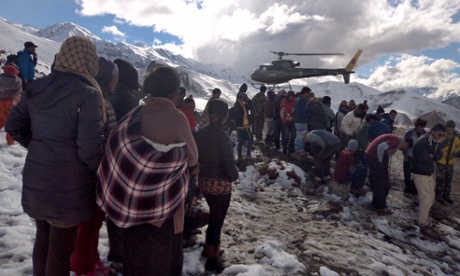
It was another busy weekend in the Himalaya, but sadly for all the wrong reasons. Search and rescue teams spend the past couple of days sweeping through the mountains in search of missing trekkers who were caught out in that horrific blizzard that struck Nepal last week. The weather has improved considerably since then, but a number of people are still missing, and feared dead, in what has become the worst tragedy in the history of the Himalaya.
Efforts to locate missing trekkers and locals were continuing today, even though the SAR teams have started to scale back their efforts. All told, more than 40 people lost their lives in the storm, while 600 had to be rescued. Most of those were in the Annapurna region, where the storm seemed to hit the hardest.
Over the weekend, the popular Annapurna Circuit was shut down, while rescue efforts were conducted. When it was finally opened again, new trekkers, just setting out on their hike, ran into trouble as well, and had to be evacuated. This prompted officials to shutdown the trail once again, in order to keep others from becoming stranded.
As recently as today, ongoing avalanches have hampered efforts to locate those who are still missing. Despite those challenges however, a search team located the body of a missing Israeli traveler, which brought the death toll to 40, with others still to be found.
Typically this time of year we focus on the climbing efforts in Nepal, as mountaineers take advantage of the good weather that follows the summer monsoons. But trekkers arrive in high numbers in the autumn too, as it is usually the best time of year for hiking in the region as well. This freak snow storm caught many off guard, including the locals who live in the mountain. This type of blizzard isn't common, even in the winter, and it arrived with so much speed and ferocity, that its strength was underestimated, which is why so many people ended up stranded and dead.
Elsewhere, the climbing teams that remain in Nepal are continuing to press ahead. The British Tri-Services team is now in place at Camp 3 on Makalu, and are preparing for the final push to the summit in the next couple of days. They'll use C3 as a launching pad for what will now become an alpine style ascent. The weather is reportedly very good, and is expected to remain that way throughout the week, giving them the best opportunity to summit that they've seen yet this season. Four members of the team will be on the move tomorrow, with the hope that they can top out by Wednesday or Thursday, depending on how quickly they can make progress along the long, and difficult Southeast Ridge.
On the other side of the mountain, the Madison Mountaineering team launched their summit bid on Saturday, but reportedly were forced to turn back due to high risks of avalanche along their route. The team has not updated its dispatches in a couple of days however, so these reports are unconfirmed at this point. Typically, if they did abandon the attempt, they would be back in Base Camp by now, and would have sent a dispatch confirming their plans. Hopefully all is well, and we'll get an update on their progress soon.
Finally, there has not been any significant updates from the Korean team on Lhotse in the past few days. The last we heard, they were preparing to push up to C3 and establish their camp at that point on the mountain. They have most likely waited out the storm as well, and will be back on the move over the next couple of days, but progress has been slow all season. Hopefully we'll get an update soon.
That's all for today. It seems then worst of the crisis has passed, although conditions remain dicey throughout the region. Hopefully there will be no more deaths due to the poor weather, and both trekkers and mountaineers will return safely from their adventures.
20 Ekim 2014 Pazartesi
17 Ekim 2014 Cuma
Video: Guilin and Yangshuo in China Captured by Drone
This video is brought to us by filmmaker Patrice Gaucher, who took his DJI Phantom drone with him to Guilin and Yangshuo, two UNESCO World Heritage sites located in China. As usual, the ariel photography captured by the drone is pretty spectacular, offering an amazing view of these beautiful landscapes.
DJI Phantom 2 Vision+ in Guilin and Yangshuo (UNESCO World Heritage Sites in China) from Patrice Gaucher on Vimeo.
Video: Adrenaline Filmmaking
A few days back, I posted a great little video that shared the secrets of how photographers capture those fantastic climbing photos that we often see. Today, I have another cool video that focuses on "adrenaline filmmaking," or the art of making adventure films in remote places. It is nearly a half-hour in length, and follows National Geographic filmmaker Bryan Smith as he offers insight into his craft. If you've ever wanted to make your own adventure films, there will be something interesting to discover in this video.
Video: No Sleep Till Bakewell - A Climbing Endurance Challenge
This short film is sure to provide some inspiration on a Friday. It is the first of a series of videos with the theme of "Never Give Up," that is sponsored by Casio's G-Shock watches. In this clip, climbers Tom Randall and Pete Whittaker attempt to 125 individual claims, and run 23 miles, nonstop over a 24 hour period. This is a challenge that they set for themselves a number of years ago, and only recently went for it. Pretty compelling stuff.
G-SHOCK Presents - No Sleep Till Bakewell from casio electronics on Vimeo.
ExWeb Interviews Steve Jones of Antarctic Logistics and Expeditions
With the 2014 Antarctic season quickly approaching, it will soon be time to ramp up coverage of the men and women who will be skiing to the South Pole this year, or exploring some other little known region of Antarctica. Ahead of the start of that busy period on the frozen continent, ExWeb has posted an interesting interview with Steve Jones, one of the main points of contact for expeditions at Antarctic Logistics and Expeditions (ALE) about the rules and regulations for traveling at the bottom of the world.
In the interview, Jones addresses a number of topics, including the use of drones in the Antarctic, the requirements for carrying not one, but two, satellite phones, and why other replacement devices won't always suffice. He also talks about the challenges that skiers face on their way to the South Pole, as their gear breaks down and deteriorates over time – something that hasn't changed in a hundred years, when the first expeditions to the Pole were finally completed.
Jones, who is a veteran Base Camp manager and guide in the Antarctica, also offers some good tips for those considering an expedition to the world's coldest, windiest, driest, and highest desert. He stresses the importance of planning, working closely with ALE, and the challenges of adapting to fluid situations as things inevitably go wrong. Steve also offers tips on getting funded, and how ALE can provide advice and even gear for those who need it.
Finally, the ALE point man also talks about the company's new trip to Mt. Sidley, the tallest volcano in Antarctica. This was the point of another story earlier int he week, and you can find out more about it here.
As the fall climbing season in the Himalaya comes to an end, the focus of the adventure world will turn to Antarctica once again. It will be interesting to see how many people will be embarking on expeditions to the South Pole this year, and if there will be any unique, unusual stories to tell.
In the interview, Jones addresses a number of topics, including the use of drones in the Antarctic, the requirements for carrying not one, but two, satellite phones, and why other replacement devices won't always suffice. He also talks about the challenges that skiers face on their way to the South Pole, as their gear breaks down and deteriorates over time – something that hasn't changed in a hundred years, when the first expeditions to the Pole were finally completed.
Jones, who is a veteran Base Camp manager and guide in the Antarctica, also offers some good tips for those considering an expedition to the world's coldest, windiest, driest, and highest desert. He stresses the importance of planning, working closely with ALE, and the challenges of adapting to fluid situations as things inevitably go wrong. Steve also offers tips on getting funded, and how ALE can provide advice and even gear for those who need it.
Finally, the ALE point man also talks about the company's new trip to Mt. Sidley, the tallest volcano in Antarctica. This was the point of another story earlier int he week, and you can find out more about it here.
As the fall climbing season in the Himalaya comes to an end, the focus of the adventure world will turn to Antarctica once again. It will be interesting to see how many people will be embarking on expeditions to the South Pole this year, and if there will be any unique, unusual stories to tell.
Etiketler:
Antarctic,
Expedition,
Interview,
South Pole
Himalaya Fall 2014: More Trekkers Rescued, Search Continues For Those Missing
I wanted to post an update on the ongoing crisis in Nepal, where dozens of trekkers are still missing, even as search and rescue operations are being conducted. The weather has improved across the Himalaya, allowing SAR teams to reach some of the areas that have been cut off for the past few days, and as a result more trekkers are being airlifted from the mountains. Sadly, the number of deaths attributed to this unexpected, and incredibly powerful, blizzard continues to rise as well, with officials saying that at least 29 people have now lost their lives as a result of the bad weather.
Earlier today, search teams were able to reach the Thorung La pass on the Annapurna circuit, where they were able to locate 40 trekkers, and evacuate them to safety. The pass was at the center of the storm, and as a result, many of the deaths have occurred near there. According to some reports, a number of the deaths occurred because the hikers caught in the pass tried to descend and escape the blizzard, with some freezing to death as a result.
Officials from the Ministry of Tourism say that the death toll will likely continue to mount, as there are still a lot of trekking routes to be checked, and heavy snow still hinders the search. Yesterday alone, more than 200 trekkers were rescued, and they suspect that there are still more waiting to be found. Operations will continue through the weekend in the hopes of rescuing more stranded backpackers, and recovering bodies.
Sadly, the finger pointing game has already begun, with some of the trekkers firmly placing blame for this disaster on the guides. In one BBC story, hikers say that the guides were ill equipped to deal with the poor weather, and made the wrong choice of continuing into the mountains, even when they knew the forecast called for heavy snows. One of the trekkers is quoted as saying that the guides pressed the team to move forward, even though the snow was so bad that it had become disorienting, and no one knew where they were going. He describes a harrowing tale of descending for two hours along a trail that no one could see, as they searched for marking poles in whiteout conditions that are described as an "abyss of nothing."
Meanwhile, over on Makalu, the British Tri-Services team have launched their summit bid as expected. They report sunny skies and clam winds as the squad begins their climb. They reached Camp 1 yesterday, and discovered one of their tents was crushed by the weight of the snow that had fallen, but they were able to make alternate means of sleeping, and repaired the damage this morning before moving up further. Hopefully they'll find conditions remain solid on their way up. The heavy snows could make things unstable, but so far the team is happy with their progress.
That's the latest from Nepal. While it seems certain that the number of trekkers killed by the storm will continue to climb, lets hope it doesn't increase by many more. With the weather improving there, the worst of the situation is now behind us.
Earlier today, search teams were able to reach the Thorung La pass on the Annapurna circuit, where they were able to locate 40 trekkers, and evacuate them to safety. The pass was at the center of the storm, and as a result, many of the deaths have occurred near there. According to some reports, a number of the deaths occurred because the hikers caught in the pass tried to descend and escape the blizzard, with some freezing to death as a result.
Officials from the Ministry of Tourism say that the death toll will likely continue to mount, as there are still a lot of trekking routes to be checked, and heavy snow still hinders the search. Yesterday alone, more than 200 trekkers were rescued, and they suspect that there are still more waiting to be found. Operations will continue through the weekend in the hopes of rescuing more stranded backpackers, and recovering bodies.
Sadly, the finger pointing game has already begun, with some of the trekkers firmly placing blame for this disaster on the guides. In one BBC story, hikers say that the guides were ill equipped to deal with the poor weather, and made the wrong choice of continuing into the mountains, even when they knew the forecast called for heavy snows. One of the trekkers is quoted as saying that the guides pressed the team to move forward, even though the snow was so bad that it had become disorienting, and no one knew where they were going. He describes a harrowing tale of descending for two hours along a trail that no one could see, as they searched for marking poles in whiteout conditions that are described as an "abyss of nothing."
Meanwhile, over on Makalu, the British Tri-Services team have launched their summit bid as expected. They report sunny skies and clam winds as the squad begins their climb. They reached Camp 1 yesterday, and discovered one of their tents was crushed by the weight of the snow that had fallen, but they were able to make alternate means of sleeping, and repaired the damage this morning before moving up further. Hopefully they'll find conditions remain solid on their way up. The heavy snows could make things unstable, but so far the team is happy with their progress.
That's the latest from Nepal. While it seems certain that the number of trekkers killed by the storm will continue to climb, lets hope it doesn't increase by many more. With the weather improving there, the worst of the situation is now behind us.
Etiketler:
Adventure Travel,
Himalaya,
Makalu,
Mountaineering,
Nepal,
Trekking
16 Ekim 2014 Perşembe
Video: America's Great Spaces in Timelapse
At just over five minutes in length, this video gives us an incredible timelapse tour of some of the best outdoor spaces in the entire U.S. The photography is brilliant, and the landscapes are breathtaking. This is a clip you want to enjoy without distractions, as it is a healthy reminder of why we love nature so much. Enjoy.
Kaydol:
Kayıtlar (Atom)