Exploration etiketine sahip kayıtlar gösteriliyor. Tüm kayıtları göster
Exploration etiketine sahip kayıtlar gösteriliyor. Tüm kayıtları göster
14 Ocak 2015 Çarşamba
Video: The Madagascar Karst Exploration Project
In October of 2014, a team of expedition divers traveled to Madagascar to explore a series of underwater caves located in the Tsimanampetsotsa National Park. The discovered some amazing subterranean chambers, and found an incredibly diverse number of fossils hidden beneath the water. The expedition was quite an adventure, and the 23-minute documentary video below tells the story with some fantastic underwater footage that has to be seen to be believed. Amazing stuff for sure.
The Madagascar Karst Exploration Porject from DRSS on Vimeo.

8 Ocak 2015 Perşembe
Julian Monroe Fisher Prepares for Fourth Leg of Great African Expedition

The Great Africa Expedition first began back in 2012, and for each of the past three years Julian has gone back to the continent to explore the changing ethnography of the indigenous people that live in a variety of regions. This year he'll be trekking through the Karamoja region, an area that crosses through Kenya, Uganda, and Sudan. That part of Africa is home to the Karamajong people, who migrated there from what is now Ethiopia around 500 years ago.
In the fourth phase of the expedition, Fisher will follow in the footsteps of Major Percy Horace Gordon Powell-Cotton (yes, that is all one name!) and Scottish hunter-explorer W.D.M. Bell, both of whom traveled through this part of Africa in the early 20th century. The Karamoja region remains mostly unchanged since that time, with very little development and few humans occupying the area.
Julian will once again be carrying a flag from the Explorer's Club for this expedition as he continues his research into the lives of native groups who have developed from hunting with bows and spears to AK-47s. He will examine how these pastoral herdsman have adapted to the modern era, and which of their unique traditions have managed to survive in the 21st century.
Fisher's route will also take him to Mount Elgon, Mount Kadam, the Kidepo Valley, and Mount Morungole, where anthropologist Colin Turnbull studied the Ik tribe of Uganda back in the 1960's. Turnbull wrote a book about the Ik entitled The Mountain People, and his graphic depiction of their lifestyle, and the hardships they endured as the result of their displacement from their ancestral lands, caused quite a stir at the time. The Ik were forced into a major famine due to their migration, which caused major problems for the tribe.
You can learn more about Julian's plans by visiting the official website of the Great African Expedition. He'll depart next week for the journey, and will spend about a month in the field. While he is there, he'll be posting regular updates to his website as well, keeping us apprised of his adventure along the way.
2 Ocak 2015 Cuma
Video: We Are Capable Of Greatness
This video combines excellent footage of the first test flight of the new Orion Spacecraft with narration provided by the late-great Carl Sagan. His words of inspiration express why man should continue to explore the stars, where he – and many people – believe our future will lie. Orion is the next step in that process, and while it is still several years away from going into service, we as a species are continuing to forge ahead as explorers, even in the 21st century.
Humans Explore: We Are Capable of Greatness from Space City Films, Inc. on Vimeo.
11 Aralık 2014 Perşembe
ExWeb Mountaineering Round Table Part 2: Cameras, Video, and Staying Powered Up

The panel consists of some big names, including Italian climber Simone Moro, and American Alan Arnette. Wingsuit pilot Joby Ogwyn is also part of the discussion, as is mountaineer and polar explorer Ryan Waters, amongst others. The panel was moderated by Tom Sjogren from ExWeb, who has climbed many big peaks, and skied to the North and South Pole.
Yesterday, the discussion mainly focused on satellite communications and staying in touch while in remote corners of the globe. The various members of the panel shared their strategies for which devices worked best for them, and what they preferred to carry when they go into the field. Today, the discussion shifts to camera equipment, with most of the panelists saying that they now take action cameras with them on their journeys, including a GoPro or the Garmin Virb. One even recommended the new Sony AX100, which is small, lightweight, and shoots in 4K.
Next, the panel moved on to how they stay powered up while at higher altitude and in base camp. Some, like Simone, carry USB battery packs to keep their gear functioning properly when high a mountain, while others turn to solar solutions from the likes of GoalZero and PowerTraveller. Back in BC, gasoline powered generators are still the best source of power, especially as more people travel with electronic gear, including guides and Sherpas.
Finally, the group talked about how they stay connected for high speed Internet while on their adventures. Most said they used the BGAN or Thuraya IP. These lightweight, yet powerful, solutions allow them to post dispatches, share photos and video, and stay in touch with friend and family. In this modern age, many sponsors want to see their athletes sharing the experience from the field, and these devices are crucial to that process.
The panel wrapped things up by discussing other tech gear that they day with them on their expeditions, including such items as foot warming systems, smartphones, and oxygen saturation meter. Some of the gear they touch on in this last section extends to everything from having proper tents, to their favorite climbing harnesses.
All in all, this two-part series from ExWeb has proven highly educational for anyone who wants to learn about the technology that keeps expeditions moving forward. I found it to be a good read, even for someone who stays on top of this kind of information. If you're planning a trip of your own, and want to be able to stay in touch with those back home, I'd suggest reading both part.
4 Aralık 2014 Perşembe
Video: Katabatic - Episode 3
EpicTV has released the third episode in their outstanding Katabatic series. These videos follow explorers Mike Libecki, Freddie Wilkinson, Cory Richards and Keith Ladzinski as they go into the Wohlthat Mountain Range in the Antarctic in search of unclimbed peaks. This is a part of the world that has seldom been visited in the past, and what these four men discovered there is almost completely uncharted.
In this episode, the team discovers a mountain that they decide they want to climb. It is a shark-fin peak that would be daunting in almost any environment, but in the Antarctic, where the weather can change in an instant, it turns into quite an ordeal. This is extreme exploration and adventure at its finest, at the Katabatic series is allowing us to watch it play out right before our eyes. Amazing stuff to say the least.
In this episode, the team discovers a mountain that they decide they want to climb. It is a shark-fin peak that would be daunting in almost any environment, but in the Antarctic, where the weather can change in an instant, it turns into quite an ordeal. This is extreme exploration and adventure at its finest, at the Katabatic series is allowing us to watch it play out right before our eyes. Amazing stuff to say the least.
2 Aralık 2014 Salı
Video: Wanderers - A Vision of Exploration in Our Solar System
The spirit of exploration still lives on in mankind, although at times it feels like we have forgotten that we are truly explorers at heart. This video is a vision of what it would be like if man were to spread out across our solar system, seeking new places to colonize and chart. The amazing images depicted throughout the four-minute short film are all real places that exist in our solar system. Those images are set to the compelling narration of Carl Sagan, a man who always championed the cause of space travel and exploration. I am confident that one day we'll remember that we are explorers, and some of the scenes depicted here may just become reality.
Wanderers - a short film by Erik Wernquist from Erik Wernquist on Vimeo.
17 Kasım 2014 Pazartesi
National Geographic Adventure Announces 2014 Adventurers of the Year

In total, there are 14 people who have earned the distinction of being named Adventurers of the Year. They include mountaineer Ueli Steck for his amazing solo-summit of Annapurna in the fall of 2013, as well as climber Tommy Caldwell, who completed the first traverse of the Fitz Roy massif in Patagonia. They are joined by ski-mountaineer Kit DesLauriers, who led an expedition to Alaska to explore the impact of climate change on glaciers there, and to more accurately measure the height of the mountains in the remote ANWR region. Swimmer Lewis Pugh get the nod for his extreme efforts in the water, but for also examining the health of the world's oceans, while blind adventurers Erik Weihenmayer and Lonnie Bedwell make the list for their successful attempt to kayak the length of the Grand Canyon. You can read about each of these men and women, and see the rest of the list, by clicking here.
Of course, Nat Geo has also opened up the voting for their annual People's Choice Adventurer of the Year as well, giving us the opportunity to vote for the person or persons, who we think made the most impressive and daring feat of the past year. Voting is open through January 31, 2015, with the winner being announced in February of next year. You can vote once a day, so be sure to check back regularly.
This is the tenth year that National Geographic has given out the Adventurer of the Year awards, and I'm proud to say that over the past few years, I've had some input on the nominees. This year, a few my suggestions once again made the cut, and it is an honor to see some of these men and women that I have followed closely since starting the blog get recognition for their efforts.
Congratulations to this year's class of Adventurers of the Year.
3 Kasım 2014 Pazartesi
In Defense of Space Travel

For a number of years now, the commercial space industry has been trying to get off the ground, both literally and figuratively. There are a number of players that are trying to get a foothold in this space, and Virgin Galactic has widely been seen as the leader out of the gate. But numerous delays have kept space tourism grounded, despite the fact that hundreds of people have already prepaid the $200,000+ ticket price to fly with the company. Many of those delays have been due to safety concerns, as Virgin has worked hard to ensure that its aircraft are working properly, and are as safe as possible, before they begin taking customers into low Earth orbit.
Fortunately, the accident that occurred on Friday was with a test crew, and not a flight filled with passengers. It is sad to know that one of the pilots died in the crash, and I send my condolences to his family. But those test pilots also knew the risks that they were facing when they signed up for the job. The customers who are waiting patiently to take the first sub-orbital trips will expect a higher degree of safety when the service actually begins operating.
It probably comes as no surprise that I am a big proponent of space travel and exploration. The same spirit that sent early explorers around the world to chart the continents and oceans, lives on in various space programs, and while we are still decades away from truly traveling to other planets, we have started to take our first fledgeling steps in those directions. For years, the U.S., Russian, and European space programs have sent manned, and unmanned, missions out into space to learn more about not just our planet, but the others in our solar system as well. Sadly, we are now in a time when the Space Shuttle is grounded, and NASA has no replacement arriving in the near future. This lull in space exploration is the result of a poor economy, and a hard-sell to the public back home.
I could go on and on about how small NASA's budget is compared to a lot of other programs in the U.S. government. I could list off all of the advancements that have come as a result of the space program over the years, including some significant products that we use on a daily basis. But the reality is that economically, many people don't want see us spending money on endeavors in space at the moment, which is why we have scaled back our plans for the immediate future.
But the commercial space industry could potentially pick up the slack, and drive us in new directions in space exploration. Sure, those private space programs are years behind those run by governments, but they are making strides all the time. In another decade, it could be quite common for travelers to pay to go into orbit, and the idea of a private space station playing host to guests is not beyond the realm of possibility.
SpaceX, which is another brainchild of Elon Musk, is already charting new paths in terms of unmanned missions, but it is possible that the company could shift focus towards other uses for its proprietary rocket system as well. The possibilities are endless, and at this point, it seems more likely that the boundaries of space travel and exploration are going to come from the private sector, than from governments who are constricted by politics and budgetary restraints.
Personally, I am of the mind that we must continue to push the boundaries of exploration in space, from both commercial and governmental entities. As a species, I feel that our future is out amongst the other planets of our solar system, and someday beyond. Those days are a long way off still, as we must take baby steps to achieve those goals. Along the way, there will be setbacks like the one we saw last Friday, but from those mistakes, we will learn to improve our technology, make things safe, and push out beyond our planet, and on to others.
The great explorers of our past were often questioned about why they would want to travel to the places that they went. There were times when it was thought to be foolhardy to sail across the Atlantic for instance, and that doing so would mean certain death. But exploration has always been a part of our DNA, and that hasn't changed even though we've filled in most of the blank spots on the map of our planet. Exploration beyond our planet will one day be as important to us as Magellan sailing around the world, or Columbus crossing the Atlantic to discover the "New World." What new worlds await us beyond our own? Someday we'll find out, and we'll be the richer for having gone.
President John F. Kennedy is famously quoted as saying about the his intentions of putting a man on the moon: “We choose to go to the moon in this decade and do the other things, not because they are easy, but because they are hard, because that goal will serve to organize and measure the best of our energies and skills, because that challenge is one that we are willing to accept, one we are unwilling to postpone, and one which we intend to win, and the others, too.”
While those words are a bit dated in the post-Cold War world, their sentiment should still ring true. At times, it seems we have forgotten those words however, and with it our ambitions to go beyond our world. In time, we will need to look to that vision once again, and go searching for other worlds to explore. In the end, the rewards will be greater than we can imagine.
30 Ekim 2014 Perşembe
Video: Our Conquest - Inspiration for Exploration
Here's an inspiring short video that uses clips from a variety of sources, overlaid with John F. Kennedy's famous speech on why we must go into space, to inspire exploration. Many of the clips are from the early days of the space program itself, but some even include images of George Mallory on Everest as well. It is a good reminder of the importance of exploration, even in this day and age.
Our Conquest from we are gods on Vimeo.
29 Ekim 2014 Çarşamba
2014 Antarctic Season Set To Begin
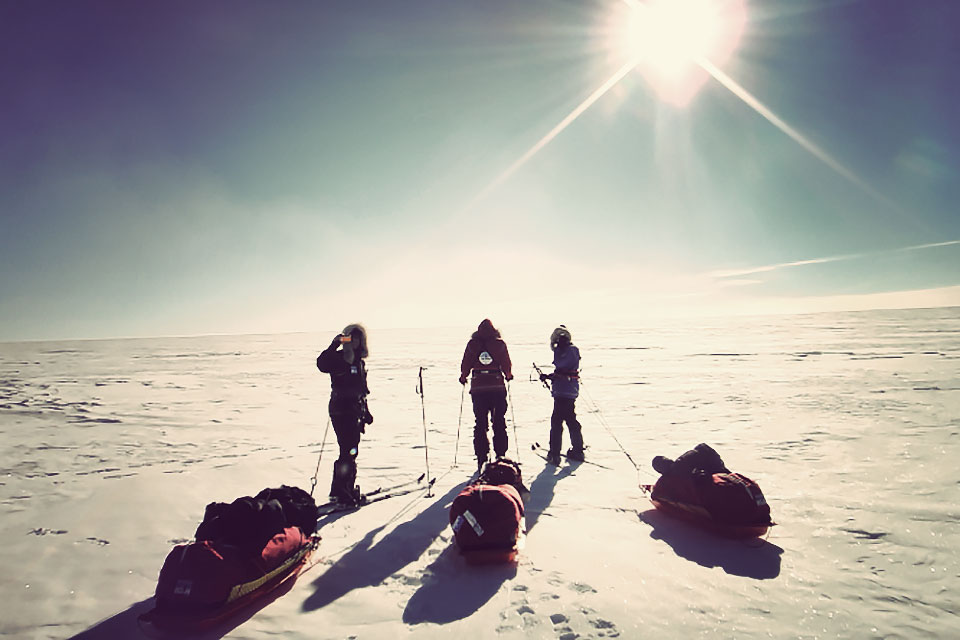 As the fall climbing season begins to wind down in the Himalaya, the attention of the exploration and adventure community will soon turn away from the mountains in a decidedly more southern direction. The 2014 Antarctic season is about to get underway, and at the moment it looks like it is going to be a relatively quiet one.
Starting each November, the austral summer opens a window for travel in the Antarctic, with hardcore adventurers making the long, arduous journey to the South Pole on foot, or attempting to climb Mt. Vinson, the highest peak on the continent. Those expeditions are incredibly demanding endeavors, and they often make for high drama for those of us who follow the proceedings closely. In recent years, there have even been a few ground breaking expeditions that have managed to not only ski to the Pole, but also make the return journey back to their starting point on the coast. For many, Antarctica remains one of the last truly unexplored places on the planet, and while logistically it is easier to get to the frozen continent these days, it still remains a harsh and unforgiving place.
As I write this, teams of explorers, scientists, researchers and adventurers are preparing to head to the Antarctic. Some will be staying at permanent research stations, which will be ramping up their staff as the new season gets underway. Others are preparing to visit more remote locations, as they go in search of new challenges in a place that continues to have an undeniable appeal to explorers, even a century after the first teams reached the South Pole.
There are two locations that offer access to Antarctica – Cape Town, South Africa and Punta Arenas, Chile. Both are used by adventurers heading to the bottom of the world, although Punta Arenas sees more traffic, in part because of Adventure Network International's (ANI) ability to provide the logistics necessary to get people on and off the continent, and support them in their expeditions. ANI maintains a camp located at Union Glacier, which serves as base of operations in the Antarctic for many private expeditions. That camp is reportedly just about ready to go, as the team has been stocking it withs supplies, and preparing the blue-ice runway that will begin welcoming flights as early as next week.
The first Antarctic adventurers are scheduled to head out on November 4, weather permitting. The past few years, the weather has delayed the start of the season, and it could happen again this year as well. The first few weeks of November can be a bit tumultuous, but South Pole skiers like to hit the ice as early as possible, as every day counts when you're skiing for hundreds of miles across a frozen desert.
In the days ahead, we will be following the action in Antarctica closely. As in years past, I'll do my best to share progress reports and updates from the field. There may not be as many expeditions heading south this year, but there will still be plenty of adventures to share. Stay tuned for more soon.
3 Ekim 2014 Cuma
Explorer Julian Monroe Fisher Announces Ambitious Schedule for 2015
In January/February of next year, Julian will travel to Uganda and South Sudan carrying Explorers Club Flag #89 on a research expedition to explore cattle rustling amongst the pastoral herdsmen that still subsist in those countries. He hopes to explore the evolution of these tribesman, who went from using bows and arrows, and spears, to AK47 automatic rifles.
Once that project is complete, Julian will then launch Phase 4 of his RailRiders 2012-16 Great African Expedition. Scheduled to take place from June to August of 2015, Fisher will be traveling overland, starting from the coast of the Indian Ocean in Mozambique. He'll set out from the grave site of Captain William Grant Stairs, a Canadian-British explorer who played a pivotal role in the exploration, and eventual colonization, of Africa. From there, Fisher will travel up the Zambezi River, through Zimbabwe and Zambia, to the Kingdom of Katanga. His journey will then take him from the source of the Congo River to Kinshasa, all the way to the Atlantic Ocean.
After he has returned from Africa, Julian will also launch a new expedition to explore the Carolina River system back home in the U.S. Over the course of two years (2015-2016), he hopes to paddle 32 individual rivers throughout the Carolinas, with those journeys being filmed for a television program. This project is entitled "Carolina Rivers -Education, Preservation through Exploration." Throughout the journey, Julian will work closely with schools to develop a curriculum tools that will instill in students a better understanding of the environment that surrounds the Carolina rivers, and the importance of preserving them for future generations.
As if all of that wasn't enough, sometime in 2015, OutWildTV will also begin airing a documentary film and television series from two phases of Julian's Great African Expedition. Those programs will cover his journey through South Sudan and Uganda. You can find out more about those expeditions by clicking here.
While I can tell you for a fact that Julian is enjoying his new gig as a radio host, I know he is also looking forward to getting back to his "day job" as an explorer as well. It seems he will have some great opportunities to do just that next year.
1 Ekim 2014 Çarşamba
Largest Cave Chamber in the World Discovered in China

First discovered back in 1989, the Miao Room has long been considered the second largest chamber in the world, behind the Sarawak Chamber in Malaysia. Measured using standard methods, the massive room is 852 meters (2795 feet) in length, and 191 meters (627 feet) wide. But the new laser mapping system is able to take into account the full size of the room in three dimensions, and it revealed that Miao is larger than Sarawak in terms of total volume. In fact, the Chinese cave occupies about 10.79 million cubic meters (380.7 million cubic feet), which makes it approximately 10% larger than its Malaysian counter part. Sarawak does cover more surface area however, stretching out across an impressive 1.66 million meters.
Expedition co-leader Tim Allen told Nat Geo that finding out that Miao was bigger than Sarawak was akin to "discovering that K2 is larger than Everest!" It has long been believed that Sarawak held the title for the largest underground chamber, but Miao has now stolen its crown.
In order to reach the massive underground room, the explorers had to first descend more than 100 meters (325 feet) beneath the surface, then navigate an underground river. These obstacle were a hinderance to exploring the cave system in the past, which is why it has taken so long to get a more accurate measurement of Miao itself. In order to properly compare it to Sarawak, the same team used their 3D laser mapping system in the Malaysian cave as well.
It is important to point out that these caves are simply the single largest chambers. In terms of the longest overall cave system in the world, Mammoth Cave in the U.S. still holds that title. It stretches for more than 651.8 km (405 miles) with new chambers and passage still being discovered.
26 Eylül 2014 Cuma
Sponsored Video: The North Face - The Explorer
We humans are explorers. There is no denying that. There is something innate in our make-up that spurs us to push on into the unknown. We want to see what is over the next horizon, and want to fill in the blank spots on the map. It is what has driven us forward as a species, and I believe it is that same spirit that will carry us forward into the future, as we continue to explore the depths of the oceans, and push further into outer space.
This point is hammered home very eloquently by the video below, thanks to some very eloquent and inspiring narration from astronaut Buzz Aldrin. On July 20, 1969, Aldrin joined Neil Armstrong on the surface of the moon, as they became the first human beings to walk on Earth's satellite. It was, beyond a shadow of a doubt, a seminal moment in human exploration
In this brief, but incredibly inspiring clip, Aldrin talks about man's need to explore is instilled in us at a young age. He says that he was inspired by the explorers that came before him, and that he hoped at some point to plant the flag someplace where no one else had ever been. He got his chance on the historic flight of Apollo 11.
Aldrin's incredibly poignant words apply not only to his mission into space, but for explorers who are pushing boundaries here on our planet as well. Those words are set over some incredibly breathtaking images of adventurers who continue to carry the torch of exploration forward into the mountains, the oceans, and the other remote corners of our planet. The video is brought to us by The North Face, so it is fitting that their motto is "Never Stop Exploring."
This point is hammered home very eloquently by the video below, thanks to some very eloquent and inspiring narration from astronaut Buzz Aldrin. On July 20, 1969, Aldrin joined Neil Armstrong on the surface of the moon, as they became the first human beings to walk on Earth's satellite. It was, beyond a shadow of a doubt, a seminal moment in human exploration
In this brief, but incredibly inspiring clip, Aldrin talks about man's need to explore is instilled in us at a young age. He says that he was inspired by the explorers that came before him, and that he hoped at some point to plant the flag someplace where no one else had ever been. He got his chance on the historic flight of Apollo 11.
Aldrin's incredibly poignant words apply not only to his mission into space, but for explorers who are pushing boundaries here on our planet as well. Those words are set over some incredibly breathtaking images of adventurers who continue to carry the torch of exploration forward into the mountains, the oceans, and the other remote corners of our planet. The video is brought to us by The North Face, so it is fitting that their motto is "Never Stop Exploring."
18 Eylül 2014 Perşembe
National Geographic Announces "Expedition Granted" Finalists

You can checkout all the finalists on the Expedition Granted website. They include all kinds of interesting projects, such as a plan to make a documentary about how climate change is creating massive floods in Bhutan, an attempt to end rhino poaching in Africa, and an examination of the health of the reef systems near some of the top surfing destinations in the world. The submissions were extremely varied, with ideas in a wide variety of fields including oceanography, medicine, education, technology, and more.
From here, Nat Geo is asking us to help select the winner. Between now, and September 29, we can all visit the Expedition Granted website to vote for our selection for the most deserving project. On September 30, the winner will be announced, and awarded the $50,000 prize to help fund the expedition.
The website has a leaderboard of which projects are currently getting the most votes, and as of this writing, it is a submission by a photo journalist named Josh Garcia to examine the most unique bioluminescent creatures on our planet. This includes things like blue squid, giant fireflies, glowing termite mounds, and so on. Josh's video is quite entertaining, so it is easy to see why he is out in front at this stage.
But there is still plenty of time for everyone to cast their votes, with more than ten days left until the winner is decided. So, drop on by the website, take a look at the different projects, and help decide who will get the funds to launch their adventure.
15 Eylül 2014 Pazartesi
Reminder: The Adventure Magazine Radio Show Begins Tonight

Last week I posted a story announcing the launch of a new radio program called The Adventure Magazine with Monroe and Gigi, which will be hosted by my friend Julian Monroe Fisher and his wife Gigi. I wanted to take this opportunity to remind everyone that the program begins airing tonight on Port City Radio 103.7 WBNE in Wilmington, NC at 6 PM Eastern Time. You will be able to listen to it live over the Internet, and the entire program will be available to stream from the website after it has aired live as well.
Tonight's first guest will be Alan Arnette, who will share stories from his mountaineering expeditions to the Himalaya and elsewhere. Alan is fresh off a successful summit of K2 this summer, and I'm sure he'll have lots to say about that expedition. Future episodes of the show will include other great guests, including Levison Wood, who recently finished walking the length of the Nile River, and polar explorer Felicity Aston.
The Adventure Magazine is sponsored by Great Outdoor Provision Company, and will be a one-hour program that airs each week. Topics will include exploration, gear, travel destinations, and much more. As it debuts, the show is running on just one radio station, but plans are in place to expand further. By the end of 2015, they hope to have it airing on as many as 25 other stations.
If you get the chance, tune in tonight and listen to the first show. If you miss it, be sure to listen to the archived version on the Adventure Magazine website. I'm sure it'll be an interesting hour for Adventure Blog readers.
Good luck to Julian and Gigi on their first show.
11 Eylül 2014 Perşembe
Introducing The Adventure Magazine with Monroe and Gigi Radio Program
I have some exciting news for adventurers and outdoor enthusiasts. My friends Julian Monroe and Gigi Fisher are launching a new radio program that will focus on some of our favorite topics here at The Adventure Blog. The show, which is called The Adventure Magazine with Monroe and Gigi, will begins airing on Monday, September 15 at 6 PM Eastern Time, on Port City Radio 103.7 WBNE out of Wilmington, NC. Those of us who live outside the broadcast area, will be able to listen to it live on the Internet, or get the archived version from The Adventure Magazine website after it airs.
Topics of discussion will include exploration, mountaineering, outdoor gear, adventure travel, extreme sports, and a host of other things that regular readers of this blog will surely appreciate. I'm told that the very first guest on the show will be none other than Alan Arnette, who will share stories about his experiences on Everest and K2 I'm sure. Monroe and Gigi if a series of other high profile and interesting guests queued up for future episodes as well. People like Mikael Strandberg, Felicity Aston, and Levison Wood.
The Adventure Magazine will start airing in just a single market when it hits the radio waves next Monday, but the hope is to have it syndicated on 25+ stations by the end of 2015. The Great Outdoor Provision Company has signed on to be the main sponsor, and there are hopes that the show will strike a chord with adventurers everywhere.
Despite having this new radio gig, Julian assures me that he isn't done with his regular job yet either. As you may recall, he is an explorer by trade, and will soon be preparing to head back to Africa for the next leg of his Great African Expedition. That is scheduled to take place next March, when he'll be traveling through East Africa once again. I'm sure that will make for great stories for the radio show as well.
Add The Adventure Magazine to your calendars for next Monday and get ready for what promises to be a fun show.
10 Eylül 2014 Çarşamba
Ship Missing for 160 Years Found in the Arctic

Today, the Northwest Passage is a very real navigational route that opens for a few months each summer. Climate change has warmed the Arctic enough that the ice that once kept the Passage permanently sealed now gives way for ships to pass through. In Franklin's day however, the route was mostly a myth that a few explorers raced to discover. Sailing the Arctic Ocean in that era was a treacherous affair, fraught with uncertainty.
Franklin's ships were named the HMS Erebus and HMS Terror. Exactly which ship has been located is unclear, but a team of explorers using sonar have found, and positively identified, one of the vessels at the bottom of the Victoria Strait. They believe that locating the first ship will provide some clues as to where the second can be found as well.
When Franklin and his ships went missing, a major search operation was launched by the British Navy. From 1848 to 1859, numerous expeditions ventured into the Arctic with the hope of locating the explorer and his men. When the hope that they could still be alive faded, the search continued to discover the fate of the crew instead. Unfortunately, no trace was found, and what happened to them remained a mystery. Over the years, there have been more than 50 attempts to find Franklin's ships, but little progress was ever made. In the 1980's, three bodies that were believed to be a part of the crew were discovered, and they contained high levels of lead in their system. That led to the theory that the sailors were poisoned by lead from the cans that contained their food. The Canadian government launched its own search back in 2008, and this latest expedition was an extension of those efforts. They were finally successful just a few weeks back.
Finding the ship sheds a bit of light on what happened, but it doesn't tell the entire tail. It is believed that the two vessels became trapped in the ice, and were slowly crushed under the weight. The crew more than likely had time to abandon ship, and escape onto the ice, where they no doubt faced a difficult challenge for survival. The local Inuit tribes, which had referenced the location of the ship for years, say that the men resorted to cannibalism in an attempt to survive. Eventually, they would all succumb to cold and starvation.
Locating the ship brings a bit of closure to one of exploration's great mysteries. We will probably never know the full tale, but at least there are some indications of what happened to the crew.
Kaydol:
Kayıtlar (Atom)